top of page

Scottish Workers Adopting GenAI, But Want Training And Guidance


A major new report from professional services firm Deloitte has found that most Scottish workers are now using GenAI at work, with those who have adopted it making clear productivity gains. However, while Scottish adoption and usage is broadly in line with the rest of the UK, a clear gap with London remains.


The findings come from Deloitte UK’s inaugural GenAI Workforce Survey, the largest study of workplace GenAI use conducted in a single country. Based on responses from 25,000 workers across the UK, collated between 7th May and 10th June 2026, the research reveals how employees are really using GenAI* in their jobs and how organisations are responding. The survey will be repeated every six months to monitor how usage evolves as the technology becomes more widely adopted.


Adoption trails London, but Scotland is no outlier

Almost six in 10 Scottish workers (58%) have used a GenAI tool for work, compared with 76% in Greater London. Scotland sits slightly below the 61% average across the UK outside the capital, however. In Scotland, 36% of respondents said they use GenAI at least weekly (compared to 55% of those in London), while 21% said they used it at least daily (with London sitting at 37%).


Over seven in ten (71%) of Scottish GenAI users say that they use AI tools that they have permission to use. However. one in five Scottish (21%) said that they use tools at work without their employer’s knowledge, believing they would approve, while a further 9% do so believing they would not, indicating around three in ten don’t have explicit employer permission.


Sentiment is broadly positive across the country. Over a third (37%) said that they see their use of GenAI for work as a positive, against 23% that see it negatively. A quarter (26%) remain neutral.


A fifth (22%) of Scottish GenAI users said that their work is more enjoyable because they’re using it, against 8% that said it is less enjoyable. The majority, 63%, said that enjoyment levels remain the same.


Time saved, but not yet transformation

Just under half of Scottish GenAI users (49%) say the tools save them time. Of those, almost six in 10 (59%) save up to three hours a week and almost one in ten (9%) save more than 10 hours.


That time is coming from routine tasks rather than complex work. Scottish users most commonly turn to GenAI for looking up information (42%), writing or editing emails (41%), summarising documents (32%) and fact-checking (31%).


Almost three in ten (28%) of Scottish GenAI users said they complete ‘some’ of their work by using GenAI. A tenth (12%) said they complete ‘most of it’ by using the technology. However, 22% said that they complete ‘hardly any / none of it’ with GenAI.


Training: an opportunity to boost usage and impact

Fewer than three in ten Scottish employees (29%) have received formal GenAI training, against 47% in London and 33% across the UK. Where it has been given, it is valued, with eight in ten (81%) Scottish recipients rating it as helpful.


A quarter (25%) of Scottish respondents said that training on how to evaluate/fact-check GenAI would be helpful. A fifth (20%) want more GenAI skills training at an advanced level, 21% would like more cybersecurity training specific to AI.


A third of Scottish employees (32%) said their employer has a GenAI policy, the same amount (32%) that said their employer does not, 36% do not know, or aren’t sure whether one exists.


A lack of trust remains in Scotland

More than half of Scottish workers (51%) are concerned about the misuse of personal data, a third (34%) cite bias or discrimination in AI outputs, and 26% worry that managers will overestimate what AI can achieve.


Additionally, nearly six in ten Scottish workers (56%) worry that essential workplace skills will suffer because of generative AI, slightly ahead of the UK figure of 55%.


Turning to leadership, 22% of workers say leaders at their organisation talk about GenAI and have a good understanding of it, while 29% say leaders do not talk about it at all.


Angela Mitchell, practice senior partner at Deloitte Scotland, said:

“Scotland is embracing technological change, supported by a skilled workforce and world-class universities. Our survey points to where businesses can go further to better support their people in harnessing GenAI to deliver lasting productivity gains and economic growth."

“Adoption rates across Scotland are strong, and workers want to learn about the technology, and understand how to use it in a responsible and impactful way. Firms across the country have an opportunity to build genuine workforce capability that moves beyond providing access to tools and focuses instead on capability, confidence and trust. Doing so will enable employees to spend more of their time on the activities that create value for firms, customers and the wider economy."


Nationally, the survey found that British workers are spending close to £1 billion a year from their own pockets on GenAI tools they use for work, with Deloitte estimating annual personal spend at £958 million.


One in six (17%) UK GenAI users pay for at least one tool themselves. In Scotland that figure is 14%, against 24% in London, while 46% of Scottish users rely on free tools.


*In this press release, GenAI refers to generative artificial intelligence: AI tools, including chatbots, that can generate content such as text, images, video and audio in response to user prompts.


Most Read

New Wellbeing Programme Sees Aberdeenshire Business Branch Out

New Wellbeing Programme Sees Aberdeenshire Business Branch Out

Two former teachers from Banchory, Aberdeenshire have built a horticultural design and care business, turning an idea into a full-time venture, with Business Gateway.

Rising Costs And Work-Life Balance Are Driving Britain’s Home Business Boom

Rising Costs And Work-Life Balance Are Driving Britain’s Home Business Boom

New research from garden building specialists Dunster House explored the booming backyard business economy, with surveying exclusively people who operate from their garden or home.

New Data Reveals Challenges Facing SMEs

New Data Reveals Challenges Facing SMEs

More than two thirds of SME business leaders are grappling with finding time to step back and work on the business due to being stuck in the day-to-day, according to new research.

Categories

Apr 14, 2025
2 min read

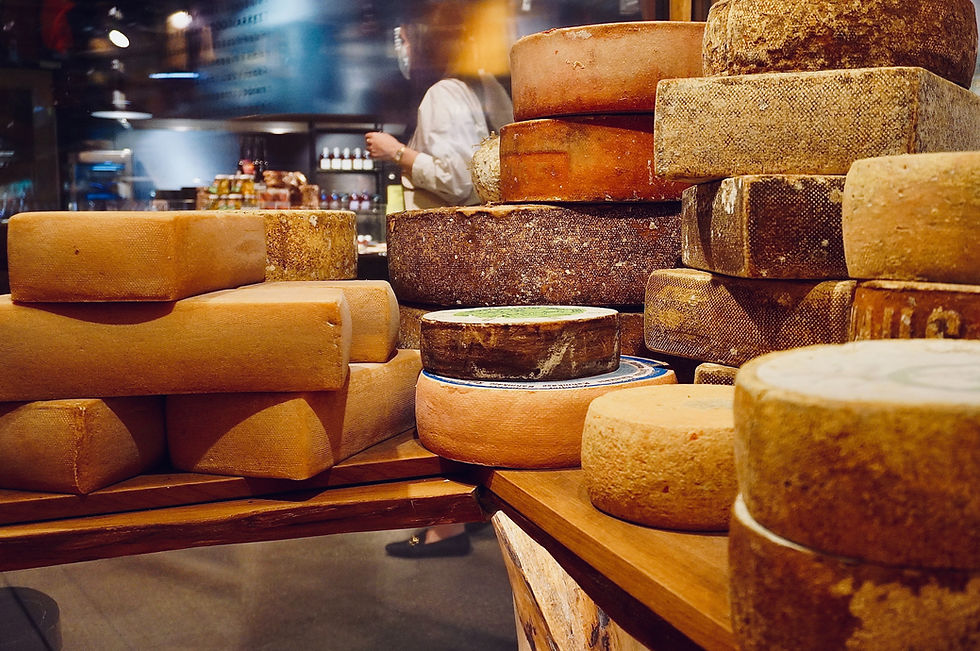
There is something profoundly comforting about cheese. Whether melted over toast, paired with a glass of wine, or savoured in thick wedges at the end of a meal, cheese holds a special place in the British culinary landscape. It is a food steeped in tradition, yet endlessly reinvented, a staple that has endured through centuries of change.


Britain’s love affair with cheese runs deep. From the crumbly tang of Lancashire to the creamy richness of Stilton, the variety produced on these shores alone speaks to a long-standing passion for this ancient craft. Once made in farmhouse kitchens and wrapped in cloth to mature in cool cellars, British cheese is now a proud emblem of regional identity and artisanal revival. In recent decades, cheesemaking in the UK has experienced a remarkable renaissance. What was once considered a fading art has re-emerged with vigour, led by small producers who are as much storytellers as they are makers. Their cheeses tell tales of landscape and heritage, from the grassy hills of Somerset to the rugged pastures of the Scottish Highlands.


For many, cheese is more than food – it’s a centrepiece, a comfort, a conversation. It appears at celebrations and quiet suppers alike. There’s a ritual to choosing it, slicing it, pairing it with the right cracker or chutney. A good cheeseboard can speak of decadence, of generosity, of care taken in curating an experience rather than just serving a snack.


Perhaps what makes cheese so enduringly beloved is its sheer versatility. It can be humble or indulgent, rustic or refined. It features in everyday classics – the grilled cheese sandwich, the ploughman’s lunch, the jacket potato smothered in cheddar – as well as in fine dining menus where its complexities are celebrated and elevated. It plays just as happily in the background as it does centre stage.


In an age increasingly aware of provenance and process, cheese has also found itself at the heart of conversations around sustainability and craft. Many British cheesemakers now focus on raw milk, heritage breeds, and traditional methods, often with an eye to preserving ecosystems and supporting local economies. Consumers, in turn, are becoming more curious, more willing to explore the stories behind the rind – how the cheese was made, where the animals graze, who shaped it by hand.


Cheese, for all its historic roots, is also quietly evolving. Plant-based alternatives are expanding, catering to a growing audience of vegans and the lactose-intolerant. Innovations in flavour and technique are emerging from modern dairies that still honour the slow, careful rhythm of true craftsmanship.


But at its heart, cheese remains delightfully simple. It’s something to be shared, something to linger over, something that brings people together. A sliver of farmhouse cheddar or a spoonful of soft goat’s cheese can evoke place, memory, and mood in a way few other foods can. It reminds us of childhood picnics, holiday lunches, or the comfort of late-night fridge raids.


In Britain, cheese is not just a food – it’s part of the cultural fabric. A source of pride, a nod to the past, and a constant presence at tables across the nation. However you take it – sliced, crumbled, melted or straight from the knife – cheese is, quite simply, one of life’s great pleasures.

Most Read

New Wellbeing Programme Sees Aberdeenshire Business Branch Out

New Wellbeing Programme Sees Aberdeenshire Business Branch Out

Two former teachers from Banchory, Aberdeenshire have built a horticultural design and care business, turning an idea into a full-time venture, with Business Gateway.

Rising Costs And Work-Life Balance Are Driving Britain’s Home Business Boom

Rising Costs And Work-Life Balance Are Driving Britain’s Home Business Boom

New research from garden building specialists Dunster House explored the booming backyard business economy, with surveying exclusively people who operate from their garden or home.

New Data Reveals Challenges Facing SMEs

New Data Reveals Challenges Facing SMEs

More than two thirds of SME business leaders are grappling with finding time to step back and work on the business due to being stuck in the day-to-day, according to new research.

Categories

Glasgow Allotment Community Grows With Revamped Facilities

Glasgow Allotment Community Grows With Revamped Facilities

Green-fingered allotmenteers in the north of Glasgow will soon have a new central space to come together, thanks to improvements planned at Hamiltonhill Allotments.

Ruby’s Co-Owner Named Rising Star Entrepreneur at 2026 DRAM Awards

Ruby’s Co-Owner Named Rising Star Entrepreneur at 2026 DRAM Awards

East Kilbride hospitality entrepreneur Struan Barclay has been recognised as a rising star of Scotland’s licensed trade after being named the winner of the Black Ivy and Montpeliers Rising Star Entrepreneur.

Nine In 10 UK Manufacturers Turn To Automation

Nine In 10 UK Manufacturers Turn To Automation

UK manufacturers remain confident about their future prospects, despite rising energy costs and ongoing geopolitical uncertainty.

Recent Posts

bottom of page