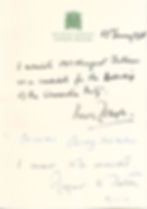


The nomination paper signed by Margaret Thatcher that led to her becoming leader of the Conservative Party is among a cache of historic material recently discovered in a cardboard box in Somerset.
It belonged to colourful Tory grandee Sir Edward du Cann KBE who was chairman of the party’s influential 1922 Committee during the leadership race in 1975. The former party chairman had been encouraged to stand himself but his stepping aside led to the election of Thatcher and ultimately to Britain’s first female Prime Minister.
Also among the cache is the historic document that changed the course of British history, confirming Thatcher as party leader.
It is simply headed: ‘Election of a leader of the Conservative Party’ and is dated 11th February 1975.
It carries the signatures of the scrutineers and that of Margaret Thatcher. She won emphatically with 146 votes. William Whitelaw came second with just 79 votes.

The nomination of Thatcher was proposed by Keith Joseph – who had also stood aside – and his note confirming the nomination was seconded by Airey Neave, who was later murdered by the IRA.
Thatcher wrote underneath ‘I consent to be nominated’ and she signed it ‘Margaret H [Hilda] Thatcher’ on January 27, 1975. This piece of House of Commons notepaper is of significant historic importance but there are other treasures.
One is a letter to du Cann the month before Thatcher agreed to be nominated, imploring him to stand. Signed by some of the party’s big beasts, it stated:
“For some time it has been increasingly obvious to a number of us that you have the qualities which are required in a new Leader: your warmth, your ability to present our case forcefully and sympathetically, your skill as Chairman, and, above all, the affection in which you are held by your colleagues, make it essential, as we see it, that you should offer yourself for the Leadership of our Party. Indeed, we consider it is your duty to do so.”
But du Cann would not change his mind and within weeks the 49-year-old Thatcher headed to the first round of voting.
The documents, found recently, are to be offered for sale at Duke’s of Dorchester on January 29th 2026.
Other treasures from the archive include notes and records from du Cann, as well as correspondence relating to the leadership election with people including the former Prime Minister Edward Heath and the Prime Minister of the day, Harold Wilson.
Also included is the nomination paper for the second round of voting and a folio of Thatcher’s signed nomination papers for Conservative party leadership ballots from later years.
Guy Schwinge of art consultants Hanover Forbes said:
“This cache of papers is of great historical importance. Margaret Thatcher was a trailblazer in every sense. Her philosophy - Thatcherism - changed the United Kingdom forever and the great personal ‘chemistry’ she enjoyed with Ronald Reagan and Mikhail Gorbachev contributed to the collapse of the Berlin Wall and the end of the Cold War."
“Interest in the papers is expected from collectors and institutions in the UK and globally. It is 100 years since her birth and 50 since she became leader of the Conservative party. The cache contains the signed nominations of all candidates in both ballots for the party leadership."
“Leading American institutions, such as the Ronald Reagan Presidential Library, are expected to keep a close eye on the sale but will need an export licence to take the archive out of the country. The files and documents were discovered in a garage in Somerset.”
Edward du Cann, who died in 2017, was an MP from 1956 to 1987, served as party chairman from 1965 to 1967 and chaired the 1922 committee from 1972 to 1984. After losing the second General Election of 1974, in October, the Conservatives had their knives out for leader Edward Heath. Because he was chairman of the 1922 Committee du Cann played a pivotal role in the machinations that led to a leadership contest.
One meeting of the 1922’s executive committee took place in Milk Street and the plotters were dubbed the ‘Milk Street Mafia’.
This period of huge importance is all covered with the documents that detail the beginning of Thatcher’s rise to party leader and from there Prime Minister, an office she held for more than eleven years, winning three general elections.
The French President Francois Mitterrand famously described Thatcher - popularly dubbed as Mrs T - as having ‘the eyes of Caligula and the lips of Marilyn Monroe’.
Another expert described the discovery as ‘utterly sensational’ and ‘without precedent’.
Auction watchers expect the archive could significantly outstrip the pre-sale auction estimate of £100,000.
She died in 2013.


