


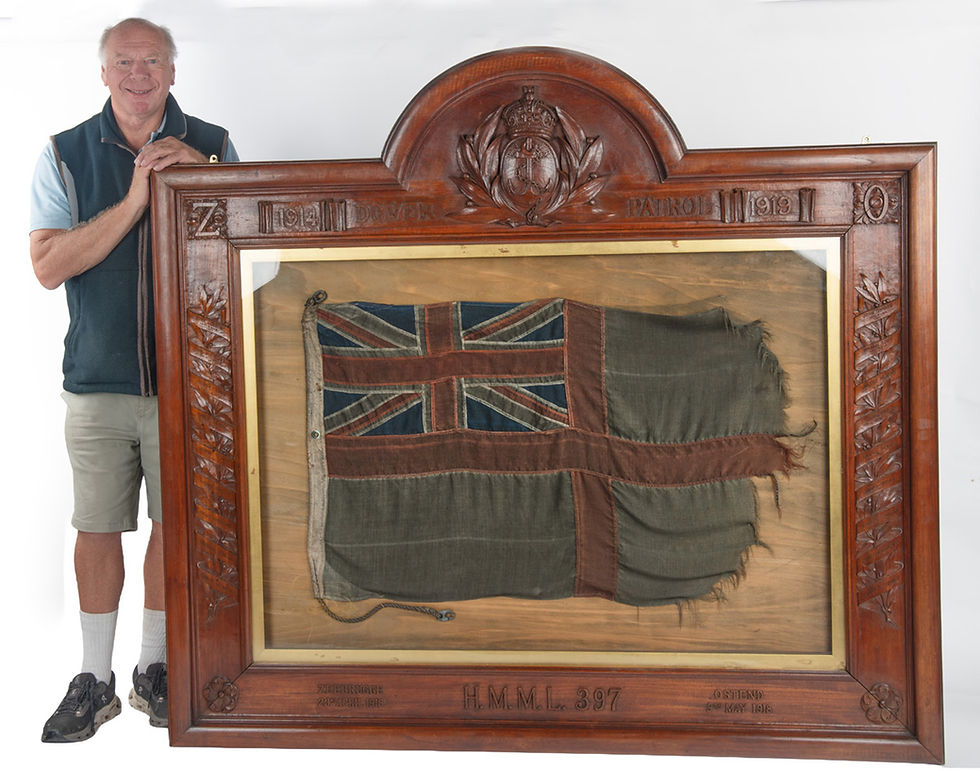
An astonishing relic from the legendary Zeebrugge and Ostend raids in World War I has emerged – shining a light on a forgotten act of heroism.
The effects were similar to that of the Dambusters mission in WWII because it boosted morale and galvanised the public, even if the success was debated.
An astonishing 11 VCs were awarded following the Dover Patrol’s cross-channel raids in 1918 during which the British fleet entered heavily-defended enemy territory. There were three raids which aimed to block the shipping canals at Zeebrugge and Ostend by sinking ships in them.
The relic that has been uncovered by leading antique dealer Charles Wallrock of Wick Antiques in Lymington, Hants, is a smoke-stained white ensign. And it will be flown again at the LAPADA antiques fair in Mayfair, London, from October 28 to November 1. The flag was attached to the stern of Motor Launch 397 which helped lay a smoke screen ahead of the main force.
ML397 took part in the Zeebrugge raid and then shortly afterwards in the second Ostend raid.
Subsequently the white ensign was framed and the names of her volunteers engraved on the decorative teak wood surrounding it, with seven names appearing twice because they served in both raids.
Charles said:
“This is a poignant relic and with the frame it is almost as tall as I am. It is an important part of our history. The raids organised by the Dover Patrol involved hundreds of volunteers who, on St George’s Day 1918, set out for Zeebrugge and Ostend on 160 ships."
“ML397 headed for Zeebrugge and bravely laid a smokescreen so the British ships and submarines could approach the port without being seen, although a change in wind direction cleared much of the smoke."
“The plan was to scuttle blockships in the main channel and for suicide-submarines loaded with explosives to blast a hole in the breakwater. One sub completed her mission in blowing a hole and three blockships were scuttled, though not necessarily in the right locations."
“The simultaneous raid at Ostend was not as successful which was why another attempt was made shortly afterwards – and again ML397 was chosen to take part. After the previous raids the Germans were on high alert and the men’s bravery was astonishing."
“The same two officers were in command of ML397 - Lieutenant John Gordon RNVR and Sub-Lieutenant William Scott - and four of the crew of seven who took part in the Zeebrugge raid served on her again. A blockship was scuttled but didn’t fully prevent German shipping getting out
“Nevertheless, the raids were viewed at home as proof of our navy’s brilliance, the volunteers’ bravery and the excellence of the military’s tactics and leadership. The vessels that took part were opened to the public on their return and the operation was hailed as a great success. Books were written about it and films were made."
“But it has largely slipped from the national consciousness, unlike the Dambusters, for example.
“This flag, still stained from those missions, really belongs on public display in Dover and I will knock its price down if someone starts a crowdfunder to raise to money."
“Hundreds of men were killed and injured in these raids and this artefact helps keep their memory alive.”
David Harper, an antique expert from TV’s Bargain Hunt and Antiques Road trip has filmed the flag. He said:
“This is a museum-quality item. It would be wonderful if it could be displayed in a museum or a public space in Dover. There is a Dover Patrol memorial in the town and this flag would remind people of the volunteers who took part in the raids and did their part in helping win the war.”
The advertised price for the flag is £37,500 but a crowdfunder to secure it for Dover could buy it for £35,000.
Liz Shanks, CEO, LAPADA, said:
“This is exactly the kinds of object that make the LAPADA Fair so interesting. It has extraordinary historical associations, being carried during two daring First World War naval raids. We’re delighted that Wick Antiques will be bringing it to the Fair this year, giving visitors the opportunity to see these remarkable pieces of history in person.”
Photo: Charles Wallrock with the white ensign from ML397


